Histopathology is a key clinical specialty in which the pathologist provides diagnosis on the basis of microscopic and macroscopic examination of tissue specimens in collaboration with surgeons, physicians, radiologists and the wider multidisciplinary team.
Histopathologists directly inform the clinical decision making process subsequently impacting directly upon patient treatment and management. It is therefore imperative that histopathologists not only have a keen eye for detail, but possess excellent communication skills and have the adaptability to be able to function well within a team and as individuals.
The specialty incorporates surgical (anatomical) pathology, cytopathology, autopsy pathology, neuropathology, perinatal & paediatric pathology and forensic pathology.
Key Skills and Personal Attributes
- Investigative/problem solving skills
- Able to utilise various sources of information including clinical, radiological and histological information
- Excellent all-round medical and surgical knowledge
- Good communication skills
- Manual dexterity, practical skills and a good eye for detail
- Ability to work as part of a team including pathologists, biomedical scientists, surgeons, oncologists, radiologists and nurses
- Able to work independently in an efficient and proactive manner
Stages of training
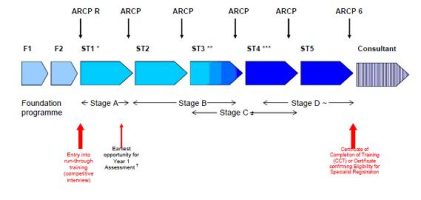
- Year One Specialty Resident doctors in training (ST1s) enter Stage A of the programme. This is an intense year of basic training in all areas of cellular pathology and culminates in an end of year assessment (Stage A Examination).
- Stage B of training takes place in year 2-3 with the focus on achieving the FRCPath Part 1 Exam.
- Stage C training takes place during ST3-4 whereby there is a focus on achieving the FRCPath Part 2 Exam, thereby obtaining the status of Fellow of the Royal College of Pathologists. Stage C allows resident doctors in training to continue with general histopathology or peruse subspecialisation in neuropathology, paediatric/perinatal pathology, cytopathology or forensic pathology. Those resident doctors in training in Stage C who wish to continue in general histopathology may opt to sit further exams in cervical cytopathology and autopsy practice if they wish to continue these as a consultant.
- Stage D (ST5+) is the final stage of training before CCT during which histopathology resident doctors in training may wish to peruse special interests in particular subspecialties.
Southwest Training Programme
In the Southwest we have 2 independent Histopathology training programmes
- South Histopathology training programme rotating across 3 Trusts – Royal Devon University Healthcare NHS Foundation Trust, Royal Cornwall Hospital NHS Trust and University Hospitals Plymouth NHS Trust
- North Histopathology training programme rotating across 4 Trusts – Somerset NHS Foundation Trust, Gloucestershire Health and Care NHS Trust, North Bristol NHS Trust, Royal United Hospitals (Bath) & Royal National hospital For Rheumatic Diseases, North Bristol NHS Trust.
South Histopathology Training programme- Hospitals
University Hospitals Plymouth NHS Trust – Plymouth Hospitals
The laboratory performs a range of tests on tissue samples in order to determine the nature of a patient’s disease. A major part of the work involves the diagnosis of cancer and pre-cancerous conditions that enables doctors to give the best type of treatment to their patients.
https://www.plymouthhospitals.nhs.uk/histopathology
Royal Devon University Healthcare NHS Foundation Trust – Royal Devon and Exeter Hospitals
The Pathology Laboratory at North Devon District Hospital provides a high quality, cost-effective service to the Northern Devon Healthcare Trust, general practitioners and community hospitals within the North Devon region. All laboratories are staffed by Health and Care Professions Council (HCPC) registered healthcare scientists, assisted by trained support staff.
https://www.royaldevon.nhs.uk/our-sites/royal-devon-and-exeter-hospital-wonford
Royal Cornwall Hospitals NHS Trust – Truro Hospital
https://www.royaldevon.nhs.uk/our-sites/royal-devon-and-exeter-hospital-wonford
North Histopathology Training programme- Hospitals
North Bristol NHS Trust
North Bristol NHS Trust (NBT) is the largest Trust in the South West region, and one of the largest Trusts in the country.
The Trust provides medical, surgical, paediatric and maternity care for its local population of approximately half a million people in the North Bristol and South Gloucestershire area. The Trust also provides sub regional, regional and supra regional services in the fields of neurosciences, orthopaedics, pathology, plastic surgery and burns, renal medicine and transplant and urology. NBT has accreditation for Colorectal (Cancer Centre), Respiratory (Cancer Centre) and Breast (Cancer Centre).
Since 2016, the histopathology departments at NBT and University Hospitals Bristol NHS Foundation Trust merged. All histopathology services (excluding head and neck pathology) are undertaken at the pathology sciences building at Southmead Hospital. This is where histopathology training is delivered and where the South West Cytology Training School is located. All autopsy training is delivered off site in a purpose built public mortuary at Flax Bourton. The hospital has close links with the University of Bristol and there are good opportunities for research, audit and undergraduate teaching. All the standard and modern diagnostic modalities are available in the laboratory including Immunohistochemistry and molecular biology
The Southwest Regional Cytology Training Centre is approved for gynaecological training by the British Association of Cytopathology (BAC) and the Institute of Biomedical Science (IBMS). The centre is equipped with a dedicated multiheaded microscope and seminar room and delivers frequent gynaecological cytopathology and non-gynaecological cytopathology training courses for colposcopists, trainee pathologists, biomedical scientists and consultant histopathologists /cytopathologists
https://www.nbt.nhs.uk/severn-pathology/pathology-services/cellular-pathology
Gloucestershire Hospitals NHS Foundation Trust – Cheltenham General Hospital
Cheltenham General Hospital is the centre of the Gloucestershire Cellular Pathology Laboratory which has a satellite laboratory at Gloucestershire Royal Hospital.
There is teaching of medical students, bio-medical scientists and more informal teaching of work experience students within the department. There are research opportunities available and the department is actively engaged in audits both with internal audit systems and also participating in all available EQA schemes both regionally and nationally.
Resident doctors in training will gain experience in histology, cytology, frozen sections and postmortem examinations. Autopsy training in a new purpose built public mortuary at the Gloucestershire Coroner’s Court Complex, approximately half a mile from Gloucestershire Royal Hospital.
https://www.gloshospitals.nhs.uk/our-services/services-we-offer/pathology/histopathology
Royal United Hospital NHS Foundation Trust – Royal United Hospitals, Bath
The Royal United Hospital (RUH) Bath NHS Trust is the teaching hospital serving the population of North East Somerset and West Wiltshire and located just over a mile from the centre of Bath. The hospital provides healthcare to the population served by three primary care trusts (PCTs): Bath & North East Somerset, Wiltshire and Somerset (formerly Mendip PCT).
The Royal United Hospital (RUH) Bath NHS Trust is the teaching hospital serving the population of North East Somerset and West Wiltshire and located just over a mile from the centre of Bath. Histopathology training is delivered in the Department of Cellular Pathology.
https://www.ruh.nhs.uk/pathology/departments/cell_path_histology.asp
Great Western Hospital NHS Foundation Trust – Great Western Hospital, Swindon
The Department of Histopathology is housed in light and airy accommodation on the top floor of the hospital. There are far reaching views of the surrounding area. The laboratory in the process of CPA accreditation and was designed in collaboration with the staff and has a linear stainer for histology and automatic cover slipper and an automated immunostainer. The MDM’s take place in the education centre with full video conferencing facilities.
Surgical specimens are received from all major specialities except thoracic surgery, neurosurgery and paediatric surgery. A wide range of material is examined including endoscopic, gastrointestinal, colposcopic and respiratory biopsies. There is a substantial amount of new tumour pathology and we have Cancer Unit status for breast (we are also the main screening and assessment centre for Wiltshire), colorectal, upper GI, ENT, gynaecology (a joint venture with Oxford), urology and lung cancers.
The mortuary is situated on the lower ground floor and is a spacious modern facility with 50 fridge spaces and pleasant accommodation for relatives. There is currently a mortuary manager a qualified APT, and a trainee APT.
There are facilities for digital photography and there is a digital dictation system. The laboratory uses the Winpath computer system. The hospital has a research and development department.
https://www.ruh.nhs.uk/pathology/departments/cell_path_histology.asp
Somerset NHS Foundation Trust – Musgrove Park Hospital
South West Pathology Service formerly Somerset Pathology Services is an integrated pathology service covering Musgrove Park Hospital, Taunton (MPH) and Yeovil District Hospital, Yeovil (YDH). It delivers pathology for most of Somerset and several treatment centres outside Somerset. The service is now run by IPP a private pathology provider with technical staff employed by IPP and medical staff employed by the NHS. Resident doctors in training are based at MPH. All the standard and modern diagnostic modalities are available in the laboratory including immunohistochemistry, molecular biology and digital pathology.
Flax Bourton
Flax Bourton Public Mortuary provides mortuary and post mortem examination services on behalf of the Avon Coroner, who covers the counties of Bristol, North Somerset, Bath and North East Somerset and South Gloucestershire. It is a new, purpose built facility located six miles from the centre of Bristol and serves as a mortuary for the Bristol Royal Infirmary (BRI) and Southmead in place of hospital mortuaries. Around 1500 autopsies are carried out per year and on-site facilities include access to a conference room, multi-headed microscope, textbooks, computers and internet access. The mortuary has access to the full range of microbiological, biochemical, toxicological, cytogenetic histological investigations as needed. Links with the Genetics lab for frozen tissue DNA extraction and molecular investigations are also available. Resident doctors in training attend the mortuary on a weekly/fortnightly basis to carry out supervised postmortems in what has become a very strong and thoroughly enjoyed part of the curriculum.