Welcome. This site will provide you with information about infection training programmes in the Southwest.
In the Southwest we have 2 separate programmes- South and North training programmes
1. South – The South region is home to two dedicated infection training centres, each offering a comprehensive four-year Medical Microbiology (MM) only programme, aligned with the Royal College of Pathology’s standards. Resident doctor in trainings progress from ST3 through to ST6, benefitting from robust clinical experience and expert guidance throughout their training.
The 2 sites offering MM training programmes are Royal Cornwall Hospital, Truro (primary site) with a 12-month rotation to the Royal Devon and Exeter Hospital, and also Royal Devon and Exeter (primary site) with 12-month rotation to Royal Cornwall Hospitals Trust.
2. North – The North region offers 3 infection programmes based at North Bristol NHS Trust and United Hospitals Bristol and Weston NHS Foundation Trust:
- Medical Microbiology 4-year training programme ST3-ST6. (Royal College of Pathologists)
- Dual training post in Medical Microbiology and Infectious Diseases 5 years training programme from ST3 to ST7. Royal College of Pathologists and the Royal College of Physicians)
- Dual training post in Infectious Diseases and GIM for 4 years from ST4 to ST7. ID GIM training sites within Royal College of Physicians. Note ID/GIM training is hosted and appointed by Medical Directorate but the Infection training components have significant overlap with aspects of the ID/MM training .For more detail on infectious disease training and for specific information about ID/GIM training please refer to the ID training pages (Severn Infectious Diseases).
Infection Training in Bristol (MM and ID/MM)
Those appointed to Medical Microbiology or Medical Microbiology & Infectious Disease training programme in Bristol will spend most of their time working at 2 sites at either North Bristol NHS Trust (NBT) or University Hospitals Bristol & Weston NHS Foundation Trust in Bristol (UHBW). This includes 4-6 months working at the UKHSA Virology reference service at NBT. This training will be spread throughout their training. All inpatient ID training is undertaken at NBT. Infection resident doctors in training are encouraged to take advantage of the research opportunities available in Bristol and may also be able to arrange to spend some time towards the end of their training acting up as a consultant or in a DGH.
Regional Training.
Regional training events in all programmes, both online and face-to-face, are well-established including formal regional training days (protected time) and a weekly Journal Club.
Curriculum
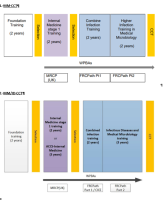
Medical Microbiology Infection Training can be undertaken as a single speciality (CCT in MM only) or combined with ID training (CCT ID/MM). Combined Infection Training (CIT) is a two-year, integrated laboratory and clinical training programme which includes medical microbiology and virology and infectious diseases. Entry is at ST3 following successful completion of Core Medical Training (CMT) and the award of the MRCP. Resident doctor in training will then progress to gain a CCT in Medical Microbiology or a combined CCT in Medical Microbiology/Infectious Diseases. Both options are offered for Infection Training in Bristol though the majority of recent resident doctor in training have elected to undertake joint MM/ID training. Only single specialty Medical Microbiology training is available in the South of the region at this time (Peninsula Medical Microbiology).
The emphasis and proportional time spent on different components of infection training within individual training programmes will vary slightly between regions, though all will comply with JRCTB and RCPath curriculum requirements. Resident doctor in training interested in infection training are encouraged to talk to current resident doctor in training in their respective training centres to understand more about individual training programmes and their strengths.
The training schedule and requirements for entry into ID/MM and MM training are outlined below – taken from RCPath and JRCTB infection training curricula.
Medical-Microbiology-2021-curriculum.pdf
Infectious%20Diseases%202021curriculum%20FINAL_0.pdf
Key Skills and Personal Attributes
Medical microbiologists increasingly have a clinical role in managing patients which overlaps with and complements the work of colleagues in infectious diseases . An understanding of how bacteriology , mycology, parasitology and virology investigations are performed and how the results generated in the laboratory impact patient care is essential. Infection specialists must be able to confidently liaise with laboratory staff about what further work to do on patient isolates and to discuss results which appear atypical or incongruous. Although as infection clinicians we are not expected to process specimens ourselves, it is very important to spend time in the Medical Microbiology laboratory to gain an understanding of the processes involved and the strengths and limitations of the available tests.
There is very varied workload, which dovetails and with colleagues working within infectious diseases and which will lead to engagement with staff and patients in all specialties within their hospital. Clinical workload will partly reflect the size and specialties of the hospitals. The work includes:
- direct bedside diagnostic and clinical advice for patients with complex infections and the increasing numbers of patients with compromised immune systems
- daily intensive care ward rounds managing patients with severe community-acquired infections, including sepsis and complex trauma or surgical cases
- participation in the multidisciplinary team (MDT) management of patients across many other specialties and also working closely with their physician colleagues on the rapid assessment of patients with imported fevers
- emergency infection advice and facilitating rapid (often overnight) diagnostics when appropriate
- working across all hospital specialties, advising GPs, working with public health experts, epidemiologists, infection control nurses, pharmacists and laboratory staff
- advice on infection prevention and control, management of outbreaks, incidents, epidemic response and the design of new buildings
- working closely with laboratory staff to ensure their safety in the handling of potentially high-risk organisms, supporting approval and commissioning of new tests and rapid point-of-care testing (POCT) in their organisations.
- Tact, diplomacy and the ability to influence colleagues (resident medical colleagues, consultant colleagues, laboratory staff, nurses, managers). Good communication and persuasive skills are very important, as is the need to build rapport with others
- Ability to work as part of a team of medical, nursing and scientific staff
- Ability to make sound clinical judgements and decisions and demonstrate clear, logical thinking and an analytical approach to problem-solving.
During their training all Postgraduate Doctors in Training will be expected and supported to take part in audit, quality improvement and research. All of the departments in this rotation are very active in research and development and there is a unique opportunity to be involved in research in a world-leading centre for research in antimicrobial chemotherapy. Effective teaching is a very important part of the role of a consultant and resident doctor in training will take part in a wide range of undergraduate, post-graduate and allied specialties teaching associated with the host Trusts.
Out of Programme (OOP) for Experience, Training or Research is encouraged for our resident doctor in training. Most of the recent resident doctor in training in infection at Bristol have benefitted from or are currently embarking on extended periods of time in research or further studies, gaining experience overseas or in specialist reference centres in the UK.
For further questions about infection training in Southwest please contact the respective departments directly.